CPQ vs CLM: Why All-in-One Quote-to-Cash Fails Complex B2B Sales
Best-of-breed CPQ architecture for teams that need validated quotes before contract handoff.
Topics
- CPQ vs CLM
- best-of-breed CPQ
- all-in-one CPQ
- Quote-to-Cash architecture
- enterprise CPQ alternatives
- CPQ CLM integration
- Quote-to-Cash software
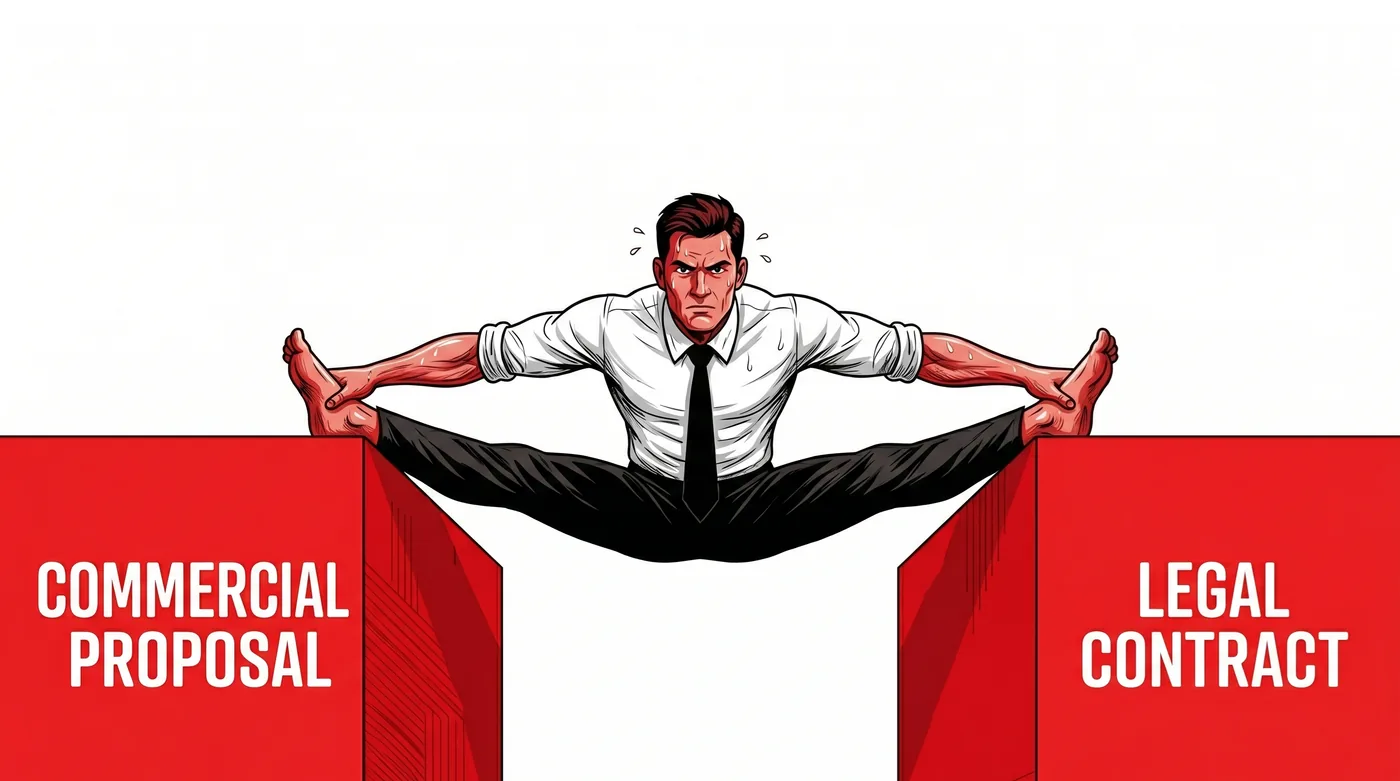
Typical RevOps manager at quarter-end, juggling the commercial proposal and the contract.
CIOs and RevOps leaders often hunt for a single Quote-to-Cash platform that covers configure, price, quote, contract redlines, signatures, and ERP sync. The vendor pitch promises one login, one data model, and one renewal conversation.
The market has responded with mimicry. CPQ vendors add "contract modules." CLM vendors add "quote builders." Legacy ERP suites bundle both under a Quote-to-Cash label and sell it as modernization. On paper, the all-in-one story wins the RFP. In production, it reliably produces the opposite of speed: reps who quote in Excel, lawyers who edit in Word, finance reconciling three versions of the same deal, and an integration team that spends quarters wiring modules that were never designed as peers.
All-in-one Quote-to-Cash is not an architecture that sometimes fails. It is a procurement category built for vendor upsell: one renewal line item, one SI relationship, one slide that says "we bought the platform." What it is not built for is daily use by sales and legal at the same time, on the same object, without someone losing.
This page explains why CPQ and CLM resist fusion, what breaks when vendors sell them as one body, and how a best-of-breed stack (with Talkulate AI CPQ as the quoting layer) replaces the broken quoting half of the monolith instead of inheriting it.
Why do all-in-one Quote-to-Cash platforms fail?
Quote-to-Cash is not one process. It is a chain of processes with different owners, different risk profiles, and different definitions of "done."
Pre-sales quoting ends when the buyer receives a commercially accurate proposal they can act on: valid SKUs, correct quantities, defensible pricing, applicable discounts. Speed and margin matter here. The buyer is warm; competitors are responding.
Contract execution ends when legal language is agreed, obligations are tracked, and signatures are captured. Control and auditability matter here. Clause 4.2 on liability cannot be ambiguous because the rep was in a hurry.
All-in-one vendors collapse these stages into a single product narrative. The buyer committee hears "one platform for Quote-to-Cash." What gets deployed is almost always a primary module (whichever domain the vendor historically owned) plus a secondary module that exists to tick an RFP box and then dies in production.
The result is not integration. It is internal fragmentation with a shared logo and a single invoice: sales lives in one submodule (or Excel), legal in another (or Word), finance in a third, and nobody trusts the official record. You pay for Quote-to-Cash; you operate a patchwork.
CPQ DNA vs CLM DNA: opposite optimization targets
CPQ and CLM are not two features of the same product. They are two species with incompatible optimization targets.
CPQ DNA: sales and finance
CPQ exists to compress time-to-quote while protecting margin. Its core jobs:
- Assemble complex configurations from a live catalog with compatibility rules
- Apply pricing matrices, volume breaks, partner discounts, and approval thresholds
- Produce a customer-ready quote or proposal while intent is high
- Support rep-assisted, buyer self-service, or hybrid flows
Success metrics: quote cycle time, win rate on time-sensitive deals, discount leakage, first-pass accuracy, quote volume per rep. The interface must feel like a sales tool: minimal friction, intelligent defaults, fast paths for repeat configurations. AI belongs here when it accelerates requirement discovery and validates against structured catalog data, as in AI guided selling for complex catalogs.
CLM DNA: legal and compliance
CLM exists to reduce legal risk and standardize contractual outcomes. Its core jobs:
- Maintain clause libraries and fallback positions
- Track versions through redlining with full audit history
- Route approvals by contract value, region, or risk class
- Capture signatures and surface renewal and obligation dates
Success metrics: cycle time to signature (from a legal baseline), deviation rate from standard terms, audit completeness, post-signature obligation compliance. The interface must feel like a control system: explicit states, clear ownership, no silent overrides.
What happens when you merge them
CLM doing CPQ: You get a risk-aware calculator. Every quote path acquires legal gates that were not designed for sub-5-minute buyer sessions. Reps wait. Buyers leave.
CPQ doing CLM: You get fast quotes attached to contract workflows with no serious redline model. Legal discovers untracked versions, ambiguous clause edits, and no defensible audit trail. Deals stall at signature after you already spent the quoting win.
Neither outcome is an integration problem you can fix with training or another SI phase. It is a product DNA conflict. All-in-one Quote-to-Cash is the bet that you can ignore it.
Dynamic configuration, discount logic, AI-assisted discovery, rep and buyer UX. Failure mode when neglected: lost deals to faster competitors.
Clause governance, redline history, approval routing, obligation tracking. Failure mode when neglected: unsigned deals, regulatory exposure, renewal surprises.
Why do sales teams abandon all-in-one Quote-to-Cash tools?
Teams that standardize on a single Quote-to-Cash monolith (especially legacy Oracle, SAP, or heavily customized Salesforce stacks) hit the same failure modes regardless of industry. These are not implementation mistakes. They are structural costs of selling CPQ and CLM as one product.
Pain 1: UX rejection
Sales reps will not tolerate interfaces built for legal reviewers. Legal counsel will not tolerate quote screens that hide version history. When a rep must complete twenty compliance fields to price a standard three-line configuration, adoption collapses. When legal must export to Word because redlining in CPQ is unusable, you have two systems of record and zero trust in either.
The symptom in RevOps dashboards: low CRM quote object usage, shadow spreadsheets, and "official" quotes that get rebuilt manually before send.
Pain 2: Expensive, slow cross-module customization
Monoliths advertise unified data models. Reality is a matrix of semi-connected modules, each with its own admin surface, upgrade risk, and SI hours. Making CPQ output land cleanly in CLM often requires custom middleware, field mapping projects, and regression testing on every vendor release. By the time the bridge works, the product catalog has changed and the business has moved on.
Enterprise CPQ programs measured in 6–18 months are not anomalies. They are the predictable cost of forcing heterogeneous workflows into one release train. Compare that to a focused AI CPQ deployment scoped on catalog validation and quote output (typically 3–5 weeks when product data is structured). In RFQ-heavy flows, the same monolith quote module still loses to faster responders on inbound requests.
Pain 3: Shallow AI
Generalist suites spread AI across modules: email assist in CRM, clause suggestions in CLM, optional copilots in CPQ. None of it goes deep on the hardest pre-sales problem: validating complex configurations against live catalog rules in real time. Surface-level AI checks a box on the RFP. It does not shorten quote cycles or eliminate incompatible BOMs.
AI that must be acceptable to legal, finance, sales, and IT committees simultaneously converges on the lowest common denominator. Best-of-breed quoting AI can adopt dual-agent architectures (conversational intake plus deterministic validation) because it is not compensating for a weak CLM module bolted onto the same SKU.
Pain 4: The renewal trap
Once the monolith is in, exit cost becomes the product. Multi-year contracts, proprietary data models, and SI-dependent customization mean you keep paying for modules sales and legal already abandoned, because migration looks worse than tolerating the split. All-in-one Quote-to-Cash does not reduce vendor count; it locks you into paying for shelfware until the next rip-and-replace program, usually years later, with the same RFP promises.
When quote prep stays measured in days, all-in-one architecture does not save you deals. It delays the proposal that would have won them.
CPQ vs CLM vs all-in-one: decision table
Use this table to see why all-in-one is the worst of both layers, not a middle ground.
If you already run a capable CLM, the highest-leverage move is not buying a bigger monolith. Replace the quoting layer that feeds CLM garbage, stale numbers, or nothing at all because reps never adopted the CPQ module.
Best-of-breed: what Talkulate AI CPQ does and what it does not
Talkulate AI CPQ follows a deliberate boundary: own validated quoting end-to-end in the stack, not a lightweight CLM pretending to close the loop on signatures.
What we optimize for
- AI-guided configuration for complex B2B catalogs: structured interviews, not static forms (product configurator architecture)
- Deterministic validation against live catalog rules before a quote is generated. Incompatible BOMs do not ship.
- Fast quote cycles: production benchmark near 5 minutes vs multi-day engineer-led flows on the same catalog types. Documented in the US server reseller case study (3,400 SKUs, 100% first-pass accuracy).
- Upsell and cross-sell mechanics encoded as deterministic rules tied to buyer signals, not generic "you may also like" prompts
- CRM handoff (opportunity, full spec, conversation context) for self-service and rep-assisted modes
What we do not pretend to do
- Replace your CLM, e-signature platform, or ERP billing module
- Manage clause libraries, redline workflows, or post-signature obligation calendars
- Serve as the legal system of record
That scope discipline is the point. A quoting layer that tries to absorb CLM becomes the same split-inflicting monolith, just smaller and easier to bypass.
How should CPQ data flow into CLM?
Best-of-breed architecture only works if the handoff is machine-readable. Manual copy from quote PDF to contract schedule reintroduces the errors both systems were meant to eliminate.
A production-grade flow looks like this:
Quote approved in CPQ
- Payload
- Configuration, SKUs, quantities, unit prices, discount breakdown, currency, tax hints, customer and opportunity IDs, all validated before approval.
Structured payload to CLM
- Handoff
- REST webhook or queue event pushes line items into contract fields or an order-form schedule. No rep re-types numbers legal already distrusts.
Legal works in CLM
- Workflow
- Redlines, approvals, signatures on top of frozen commercial data. Commercial changes loop back through CPQ, not silent Excel edits.
CRM and ERP stay aligned
- Sync
- Opportunity stage, quote version, and contract ID link across systems. RevOps sees one thread from first quote to signature.
Talkulate integrates with major CRM platforms (Salesforce, HubSpot, Pipedrive) for the sales-side record. CLM integration is scoped during implementation: connectors and field maps depend on your contract stack (Ironclad, Juro, Sirion, or another dedicated CLM), not a fictional universal module inside CPQ.
The outcome: sales stops routing quotes through Excel, legal stops re-keying numbers they do not trust, and RevOps stops paying for a Quote-to-Cash SKU nobody uses end-to-end. The bridge is data, not another monolith module.
IT director checklist: diagnose your stack
Answer honestly. The pattern of "yes" answers tells you whether to invest in quoting, CLM integration, or decommissioning unused monolith modules.
How to read results:
- First two items → prioritize a dedicated AI CPQ or guided selling layer, not CLM replacement.
- Middle legal items → fix data handoff from CPQ to CLM; legal’s distrust is usually a sync problem.
- Architecture items → stop funding monolith modules nobody uses; fund integration and the bottleneck layer.
- Last item → pilot Talkulate on one catalog line with explicit KPIs: quote cycle time, first-pass accuracy, rep adoption.
Sources
Conclusion: stop forcing the split
One system cannot simultaneously maximize quote velocity and legal control without compromising both. The all-in-one promise persists because it sells well in procurement, not because it works in complex B2B catalogs. Teams that wait for the monolith to "finish phase two" usually lose deals in phase one.
The fix is not a better all-in-one. It is composition: a quoting engine sales will actually open, a CLM legal will actually redline in, and an API layer between them, instead of a single vendor invoice for two half-dead modules. Heavy Quote-to-Cash suites are a tax on organizations that bought the slide deck. The teams winning on cycle time bolt on a real quoting layer and stop funding the split.
If quote prep is where deals die (not signature workflow), Talkulate AI CPQ is built to replace that broken layer. Compare quote cycle time against the CPQ module you already pay for. Your CLM stays in place; the workaround stack does not.
Frequently asked questions
Can one platform handle both CPQ and CLM well?
In practice, no: not at the level a mid-market or enterprise B2B team needs. CPQ must optimize for configuration speed, pricing logic, discount governance, and rep adoption. CLM must optimize for version control, legal review, obligation tracking, and audit trails. Those goals conflict in UX, data model, and release cadence. Vendors that claim both usually ship a strong module in one domain and a checkbox in the other. Buyers who need both typically run a dedicated CPQ or AI quoting layer integrated to a dedicated CLM via API, not a single monolith pretending to be expert at both.
What is the difference between CPQ and CLM?
CPQ (Configure, Price, Quote) is the commercial engine: it assembles valid product configurations, applies pricing and discount rules, and produces a quote or proposal while the buyer is still engaged. CLM (Contract Lifecycle Management) is the legal engine: it manages template libraries, redlining, approvals, signatures, obligations, and renewal. CPQ outputs commercial truth (SKUs, quantities, prices, discounts). CLM outputs legal truth (clauses, liabilities, term lengths, signatures). The handoff between them should be structured data, not copy-paste.
Why do sales teams abandon all-in-one Quote-to-Cash tools?
Three recurring reasons: UX built for legal workflows slows quote creation; customization to make modules talk to each other takes months and still feels brittle; and AI features are spread thin across modules instead of going deep on catalog validation and guided selling. When quote prep takes longer in the system than in Excel, reps route around it. RevOps sees low adoption; leadership sees low ROI on a seven-figure license. The failure is architectural, not a training problem.
How should CPQ data flow into CLM?
After a quote is approved in CPQ, push a structured payload (line items, SKU IDs, quantities, unit prices, discount breakdown, currency, customer ID, opportunity ID) to CLM via REST or event-driven integration. CLM maps that payload into contract fields or an order form schedule. Legal teams redline clauses in CLM; they should not re-enter commercial numbers that already passed validation in CPQ. Talkulate AI CPQ follows this pattern: it owns configuration and quote accuracy; your CLM owns contract language and signature workflow.
Is Talkulate AI CPQ a replacement for CLM?
No. Talkulate AI CPQ is a specialized AI configure-price-quote layer for complex B2B catalogs. It does not replace DocuSign CLM, Ironclad, Icertis, or similar systems, and it should not try. It replaces the slow, error-prone pre-sales quoting bottleneck and passes validated commercial data to whatever CLM or CRM contract module you already run.
Why do enterprises still buy all-in-one Quote-to-Cash?
Procurement logic, not architecture. One vendor on paper, one renewal cycle, one SI partner, and an RFP checkbox for CPQ and CLM in the same row. Sales and legal requirements are opposite; the bundle hides that conflict until after signature on the enterprise agreement. By then, the quoting module is under-adopted, the CLM module is under-used, and shadow tools (Excel, Word, email PDFs) carry the real workflow. Teams that need speed on quotes should not wait for the monolith program to finish. They add a best-of-breed quoting layer and integrate out, which often ships in weeks while the suite project is still in phase one.
What should IT directors ask before buying an all-in-one suite?
Ask for production evidence, not roadmap slides: median quote cycle time for complex SKUs, rep adoption rate at 90 days, cost and duration of cross-module customization, and whether legal actually uses the CLM module or still redlines in Word. If sales and legal each use a different workaround, you already have a split stack. You are just paying monolith prices for it.
Stop Stretching Sales Across a Monolith
Talkulate AI CPQ focuses on one job: validated quotes for complex catalogs in about 5 minutes. It hands commercial data to your CLM and CRM via API. Monthly platform from $1,150/mo, with a 3–5 week path for standard catalogs.