Hosting Industry AI, August 2026: The Adoption Race
Topics
- hosting industry AI 2026
- AI site builders hosting
- hosting sales assistants
- post-sale AI agents hosting
- hosting support AI
- control panel MCP
- Web Hosting Trends Report 2026
- Talkulate AI CPQ hosting
Why hosting is a high-volume, tech-edge market
Hundreds of clients a day, constant acquisition, constant plan comparison. Hosting is one of the densest commercial markets, and it is hybrid: indie developers, startups, small businesses, and corporations sit on the same product line. That mix drives volume while putting pressure on price and quality.
On that flow, the work has to be as automated as possible and still personalized. A manual queue cannot keep up. A single SKU cannot fit every workload. Next to the storefront sits heavy operations: servers, control panels, billing, tickets, uptime. Once a plan is sold, the customer is already inside that machine.
Those customers are tied to IT in one form or another. You do not have to introduce new tools through fear, or through hundreds of hours of webinars. They want speed and convenience. Builders, agents, MCP, and sales automation follow from that. Hosting strives for maximum automation: to survive, to win the customer, and to turn that into profit.
The hosting AI stack in August 2026
CloudLinux and WebPros, Web Hosting Trends Report 2026 (n=446) [1]: 53% named AI-driven automation and AI products as the trend with the biggest impact on hosting in 2026. 32% already offer AI tools to customers. 36% already use AI in support. 27% have no AI in place yet. 36% name integrated AI and automation as the main control-panel innovation bet for the next two to three years.
AI as a single feature is a dream. We segment the work by job into five layers; vendors bet on different ones:
| Layer | What it does | Why it exists |
|---|---|---|
| L1 AI site builders | Build a site or app for the visitor, then sell the hosting that runs it. | Products like Lovable proved the model: build the site, host it in the same flow. Hosts want those buyers: people who are not technical and who get lost in VPS setup and plan tables, and people who would otherwise pick Wix or Shopify for a simpler setup. |
| L2 Sales assistants | Recommend a hosting plan for what the visitor actually needs, without a human on every visit. | Get more visitors to buy a plan. Reach buyers who get stuck on a plan table. Let an assistant guide the purchase so the visitor does not have to guess. A wrong guess means they leave, or they pay, regret the plan, and open a ticket. |
| L3 Post-sale agents (day-2) | After the sale, run the site, the store, or a visitor front desk for customers who already have a site. That is day-2: keep the site and the business running once the plan is paid. | The customer has no tech team. This holds onto small, non-technical accounts that would otherwise move to a simpler all-in-one builder like Wix or Shopify. Hosts also charge extra for the agent, the front desk, or paid AI usage packs. |
| L4 Ops / tickets | Answer support tickets and fix routine server problems. | This is where hosting AI landed first. Ticket volume hits profit hard and fast. Hosts want a shorter queue, a faster first reply, and fewer simple tickets that still need a human. |
| L5 Panel / MCP | Put an assistant inside the control panel, and let coding tools manage hosting from the IDE. | Dev teams now ship with AI coding assistants. Teams use Cursor, Claude Code, and Codex in daily work. Once one panel or host ships an MCP connector, competitors follow. |
Keep one line distinct from this table: selling AI infrastructure (GPU servers, agent hosting, AI VPS). That is a capacity product. It does not run the hoster's own builders, plan help, day-2, or support.
From here, each layer: what changes for the provider, and what changes for the client.
Builders: AI that sells by creating a site or app
Why create-to-host spread after Lovable (2026)
The loudest layer in August 2026 is selling by creating a site or an app. The model was proved outside hosting first. Lovable reported about $500M in annualized run rate by June 2026; in August it closed a $400M Series C at a $13.3B valuation; the company says the platform hosts about 60 million projects and draws on the order of 900 million monthly visitors [3]. In Lovable's own audience cut, the company says most builders come without a classic developer background [3]. When that kind of demand goes into "build it yourself and it is live," hosts mirror the model: build and hosting in one flow.
Retail AI builders, panel paths, and what each side gets
That is the wave behind GoDaddy Airo, IONOS Momentum, Hostinger AI Builder, and Bluehost. The job is the same: the visitor describes the task, gets a site or an app, and hosting rides along. The sale is about the result. The Shared / VPS grid is often hidden behind the builder and credits. Airo and Momentum go straight into building an application [6][8]. On 18 August 2026 Hostinger merged Website Builder and Horizons into AI Builder [4]; on Horizons the vendor writes about one million-plus people who tried it [5]. Bluehost reinforced the builder line in its July 2026 acquisition narrative [9]. In earnings, Airo claims about $50M in annualized bookings run rate, and more than 70% of Airo users hold two or more GoDaddy products [7]. Mid-market hosts without a large retail create storefront add the builder through the panel: Nova, Sitejet [10].
For the provider, this is an acquisition channel and a place to attach domain, email, SSL, credits, and commerce in the same path. For the client, it is minutes to a live site and a low skill floor, plus the usual publish/credit gates and uneven export lock-in. 41% of providers see customers leave for SaaS such as Wix and Shopify [1]: convenience without a server grid. We covered the same tension between a convenient third-party stack and one you own in Custom Is the New Black. There are still no independent studies of builder conversion against a pricing page; the Lovable, Airo, and Horizons figures above are company and vendor claims.
Create is loud. Picking a plan for a workload is a different layer.
Sales assistants: AI that picks a hosting plan
Some buyers already arrive with a task: a CRM for 50 people, a store, a Node app, an agency stack. They do not need a blank canvas. They need a plan that can run it. Most cannot map their case to real load and a plan row. They can ask a general GPT, but then the recommendation leaves the host's page, and the answer can include ads or a competing brand.
A sales assistant runs that scenario on the provider's storefront: understand the task, return a plan with a price, push toward the order. For the host the stake is simple. Less friction on the choice means more orders from the same page. Fewer manual "which plan?" replies. Conversion rises from clarity of choice. For the buyer the stake is simple too: stop guessing from the table, and avoid a plan that will not hold the load and then open a ticket.
Those assistants sit on storefronts: UltaHost UltaAI, VedHost Ved AI, and the plan path inside Hostinger Agent [11][12][14]. Mid-market hosts get similar recommend modules in the WHMCS ecosystem [15]. Below is a live look at four paths on the same request.
Current sales assistants: a live look
We ship Talkulate AI CPQ for Hosting, so we needed a clear view of how live sales assistants work on hosting storefronts. We did not rank engines or open model internals. We opened public surfaces and recorded what a buyer actually sees in the chat and beside it.
For a quick check we took four storefront paths and one basic request that non-technical clients often send: a server for a CRM for 50 people. The live checks are dated 31 August 2026. That freezes a UX sample on a calendar day. It is a live look at what ships on those pages, without conversion math and without a census of the whole market.
Of the four paths, three run a conversational sales assistant. Across the wider industry those surfaces still show up less often than builders and support AI; surveys do not publish a clean share for this layer, so we stay with what we opened. The fourth path used a rigid path quiz instead of an assistant.
Hostinger Agent. On a single request the assistant named KVM 2 an excellent fit, rendered a BEST MATCH plan card in the chat with price, specs, and a Get KVM 2 plan button, and told the user to choose from the card. When the user asked whether the agent was sure after only one question, the tone softened: KVM 2 became a starting estimate, and only then did clarifying questions appear about which CRM and how many people may use it at the same time.
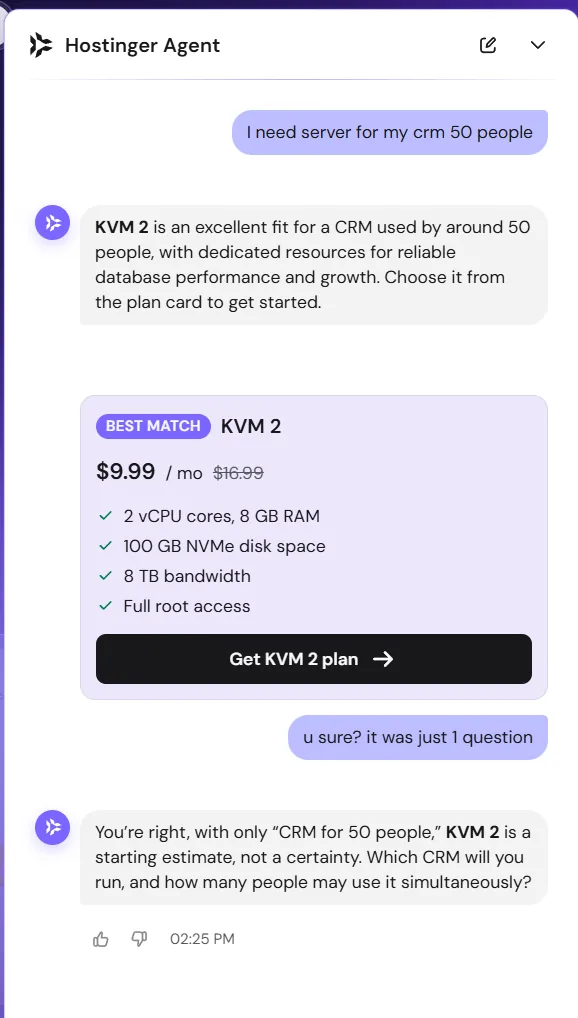
One request → KVM 2 plan card and CTA before any discovery.
UltaHost UltaAI. The same request steered straight into the VDS line: a strong match, a "5 plans found" widget, and a Recommended Plans rail on the right filled on first reply, with POWER Pro as BEST MATCH and Order Now on the cards. A personalized path was offered after that first recommend. On "u sure?" UltaAI kept VDS and mentioned how heavy the CRM might be (automations, reports, attachments), without turning those factors into clarifying questions before the rail.
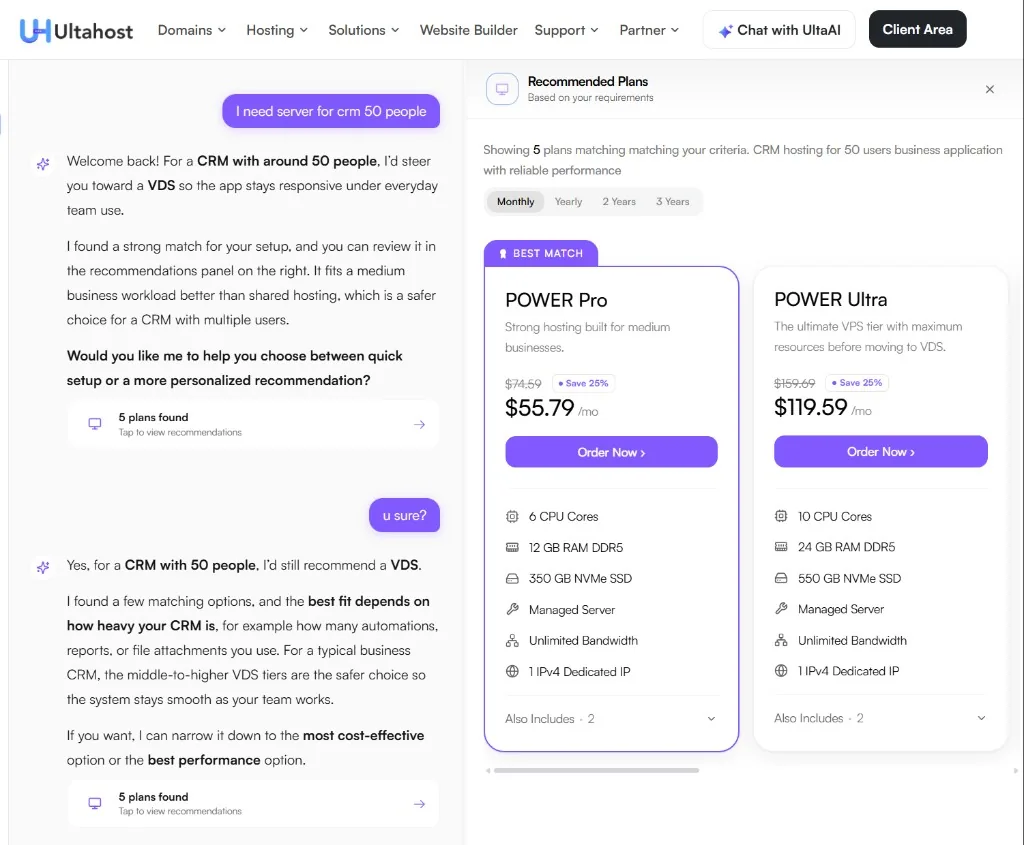
Same request → VDS plus a five-plan rail; discovery stays optional.
VedHost Ved AI. Here the assistant first confirmed the VPS line and asked two short questions: a heavy custom stack or a standard CRM, and USA or India as the region. After an answer about Node, PostgreSQL, AI automation, and USA, it named USA-EX8 with a price and a link to the VPS page, labeled Live WHMCS pricing. There is no plan card in the chat: the pick exists in text, and the order path stays on the catalog page.
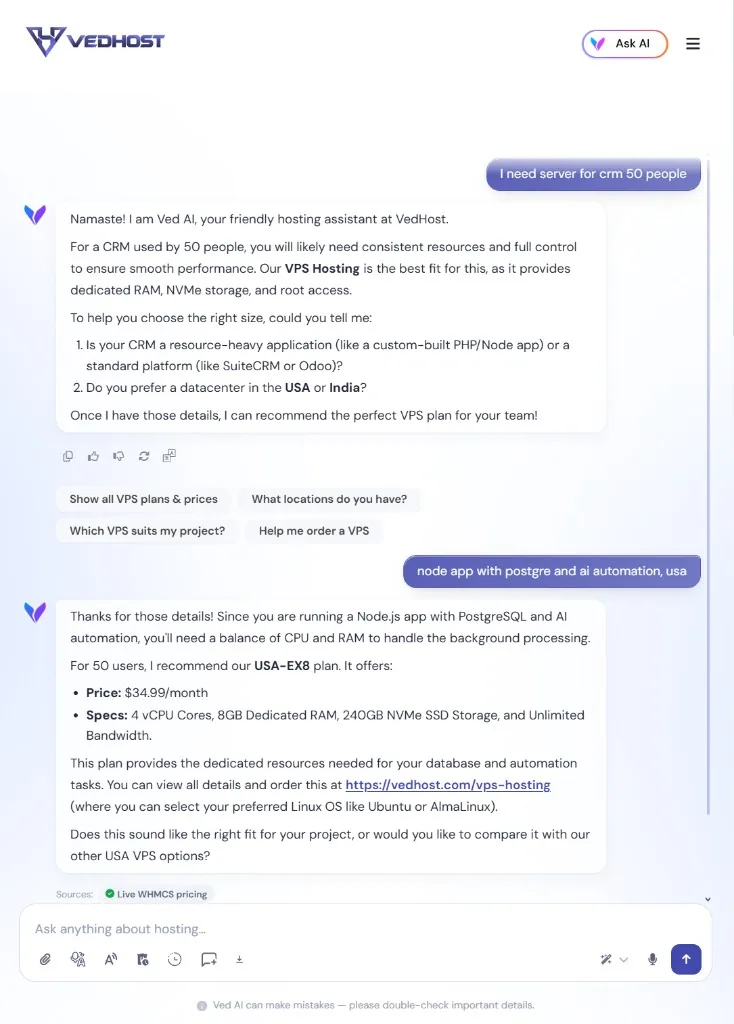
Two short questions, then a named VPS in text and a catalog link.
Bluehost Help me choose. A modal opens at STEP 1 OF 2: Pick your path / What's your big move? The options are fixed goal cards, including Make AI work for me, 24/7. This is a rigid path quiz. We expected an assistant that would unpack the workload and lead toward a hosting plan; on this step AI is a label on one of the goals.
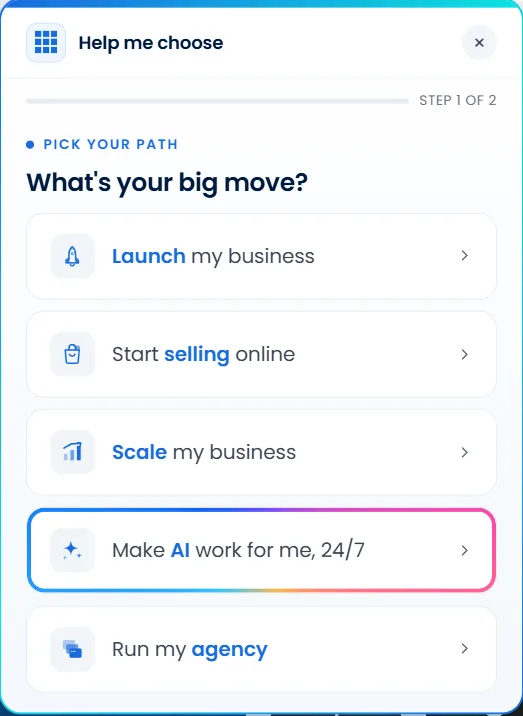
Fixed path quiz only; we expected a plan assistant.
Consultation quality
On Hostinger and UltaAI the first move follows the same sales logic: an instant recommendation without the extra questions you need to understand the situation and choose a sound fit. "CRM for 50 people" sounds concrete to a buyer, and for sizing it is still a thin intake. Concurrent load, CRM type, data volume, automation peaks, region, and how managed the server should be stay off-screen while the storefront already shows a BEST MATCH and an order button. The confidence in the wording runs ahead of the context that was collected.
Catch-up on context often starts only after the user pushes back. When someone asks "u sure?" or notes that it was only one question, the assistant softens the estimate or holds the category, and only then names factors that belonged in the interview earlier. For the provider that can look like a fast path to a card. For the buyer it raises the chance of taking a "close enough" plan and opening a ticket later when the load looks different.
In this sample, consultation quality is still early: plans fire first, and clarifying questions arrive late.
Sales UI maturity
The sales UI also splits hard on the same job. In this sample Hostinger sets the clearest bar: the plan card renders inside the chat, so price and CTA sit in the same flow as the answer. UltaAI brings strong catalog density with a split screen: chat on one side, a Recommended Plans rail on the other; the recommend sits in the rail while "personalization" is still only an offer. VedHost stays on plain chat: a named plan and price in text, a catalog link, and no in-chat plan card or buy widget. That is a different stage of sales UI maturity, even when the assistant manages two short questions before the SKU.
Outside these three assistants, many hosts still ship a classic rigid quiz in the Bluehost Help me choose pattern: fixed path cards instead of a workload-to-plan interview. The storefront may highlight the word AI while hosting-plan choice stays a wizard of preset goals.
Taken together, what we opened on 31 August 2026 shows sales assistants as a real layer you can open on a live storefront. The path to order is still basic on these surfaces: packed into a card, split across the screen, handed off as a catalog link, or replaced by a preset-goal quiz. Read our detailed breakdown of this problem.
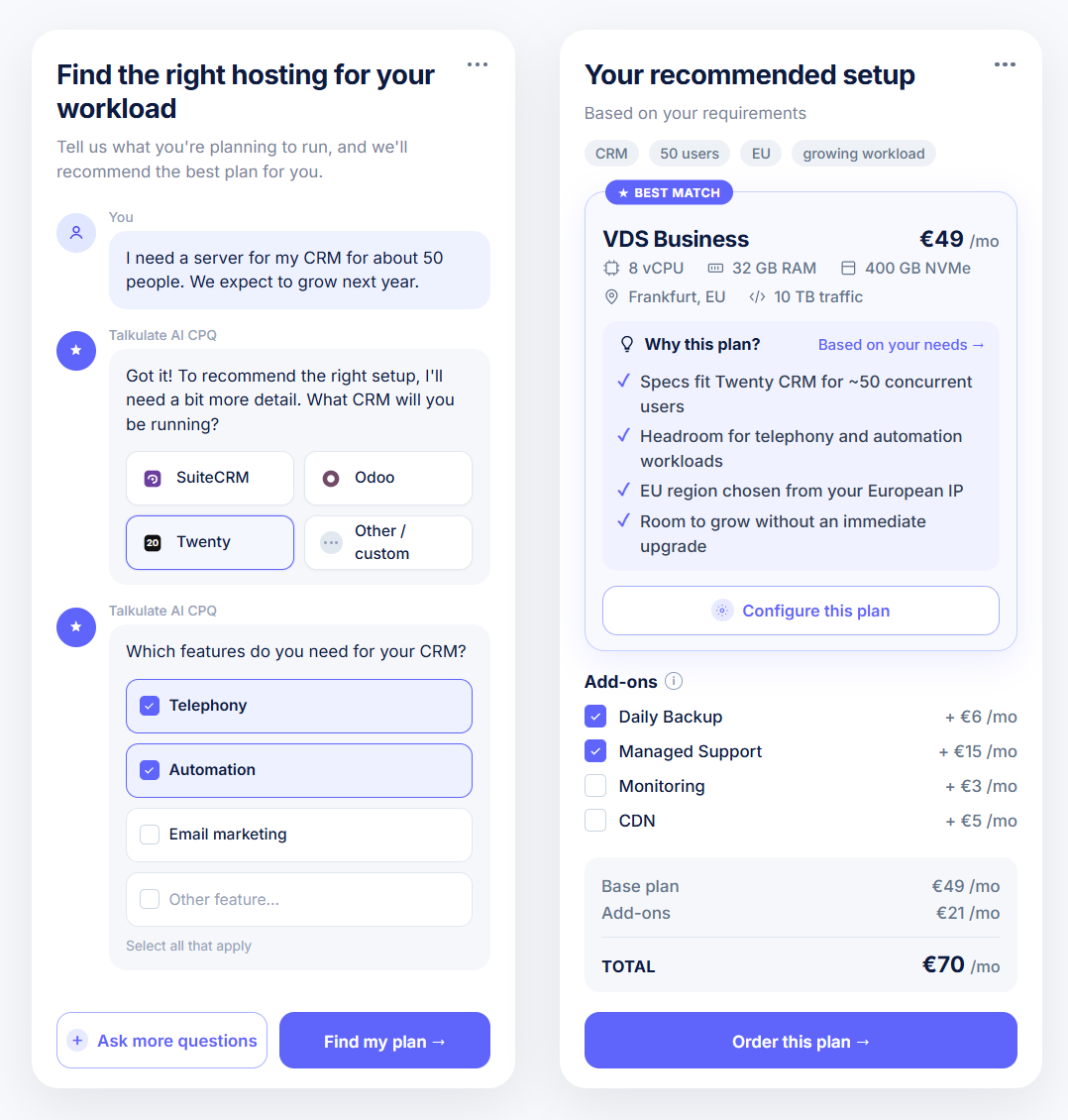
Talkulate AI CPQ for Hosting. We ran the same CRM-for-50 request through our own path so the gaps above sit next to a concrete UI. Discovery comes first: the assistant asks which CRM (Twenty selected), then load clues such as Telephony and Automation, before any BEST MATCH card. The recommend step shows VDS Business at €49/mo in Frankfurt with a Why this plan block, Daily Backup and Managed Support as selected add-ons, a €70/mo total, and Order this plan in the same flow.
Talkulate AI CPQ for Hosting
12–18%
was 2–5%
Conversion rate
5 min
was 1–3 days
Quote cycle
100%
was 76%
First-pass accuracy
// What you get
These are the gaps we close: unpack the task and the load first, then show a fitting plan with a price and carry the buyer toward order on the provider storefront. The product can roll out quickly for a hosting provider.
Post-sale agents: AI that runs the site after the sale
Through 2026, large retail hosts grew a post-sale agent layer. After the plan is paid, a chat appears in the Client Area, hPanel, or store dashboard and runs the site, the store, marketing, and the visitor front door. In hosting that post-checkout work is day-2. The market move is simple: the host stays with the buyer after checkout and sells that work inside the host account.
Why day-2 agents exist
Why the layer exists shows up on both sides. For the provider, new customers are expensive, and small businesses without a tech team can leave for a convenient all-in-one. 41% of providers see customers leave for SaaS such as Wix and Shopify [1]. On that backdrop, post-sale agents give a way to hold the account and attach a separate charge for tokens, an Agent subscription, or a front desk. For the client, other work starts after purchase: content, catalog, SEO, orders, email, answers to visitors. Without an IT team, that means hours in the admin or a hire. An agent in the host account closes those hours through conversation.
How it ships in August 2026
Three examples from August 2026 storefronts.
At SiteGround the layer sits on AI Studio: multi-model chat, more than fifteen business agents, a free Essential allotment of 20,000 tokens a month, and paid Plus when the limit runs short [16]. The AI Agent for WordPress connects to a live install and executes admin work from chat: posts and pages, menus, SEO fields and alt text at scale, plugins and users, WooCommerce orders and category-wide price changes, catalog translation, and the same actions across several sites for agencies. Risky deletes and bulk edits sit behind Power Mode, which is off by default [17]. Inside SiteGround Ecommerce, the AI Store Agent answers store questions such as top products, order trends, coupon use, and products without reviews. With Power Mode on, the same chat creates coupons, adds products, and runs catalog edits. It ships on Sell, Grow, and Scale and spends the same AI Studio tokens [18].
At Hostinger the story moved in two steps into one UI. In April 2026 Hostinger Agents launched at about $6.99 with 1,000 credits and seven specialists: North for strategy, Quill for copy, Scout for SEO, Buzz for campaigns, Shield for privacy and terms drafts, Ally for client email, Arrow for outreach and pitches, plus Atlas to enter site context quickly. Kodee covered DNS, setup, and hosting help [19]. Later Kodee and Agents merged into one Hostinger Agent in hPanel [14]. The chat offers Support or Agent mode. Support helps with the account, hosting, and sites and does not meter troubleshooting. Agent opens business work and agentic tasks such as files and scheduled jobs, and bills credits by complexity.
At Bluehost the post-sale line is help running the client's business. AI Store runs the shop through conversation and an Action Plan in Command Center; the July 2026 PR says Store can work with Bluehost hosting or with hosting the client already has [9]. AI Front Desk sells separately at about $25 a month or $300 a year and sits on the SMB's visitors: answers questions, captures leads, and ties into the calendar [20][21]. The host sells server space and an entry line for the client's end customers.
What each side gets
What each side gets follows that move. The provider gets attach inside the account: Studio Plus, Hostinger Agent credits, Bluehost Front Desk, and more day-2 work so the client builds fewer tools outside. Create builders and post-sale agents often sit together on the same brand because the account life cycle runs both phases. The client gets concrete operators for the work: live WordPress edits, store analytics and changes, specialist help on content and marketing, and a receptionist for storefront visitors. Free tokens, free Support, and clear prices on credits or Front Desk keep the entry floor low.
Support and tickets: AI that clears queues
Why hosting support AI reached mass use in 2026
In 2026, AI in hosting support is in mass use. 36% of providers use AI in customer support, and 37% put it on the wishlist [1]. Ticket queues and repeating incidents hit profit and first-reply speed, so the layer grows as automation of cost-to-serve.
Ticket automation, self-heal, and vendor-reported gains
For the provider the point is direct. The first line burns staff on the same questions and outages. AI takes some of the escalations to a human, shortens time to first reply, and moves a share of that work into an AI module fee or a reply pack. Konrado.AI at Gigacore, in a July 2026 vendor case, shows a 70% drop in first-line tickets that needed human escalation, and first reply time from 16 hours to 30 minutes [22]. Cloudways, in vendor-reported GA figures, compares incident handling at about 5–6 minutes against 30–40 minutes for a human [23]. Mid-market density comes through Blesta 6.0, HostBill AI, Synapse, and helpdesk modules in the WHMCS ecosystem; percentages on those vendor sites stay their claims [24][25][26].
For the client the point is direct too. A routine outage and a routine question close faster. On the self-heal path the fix waits for confirmation: the system finds the cause, the person allows the action on the live server. That is how SmartFix works at Cloudways [23].
The market assembles this as queue automation on ticket text and recovery on live infrastructure. The shared style in 2026 is AI with gates and confidence thresholds, so write actions on the server wait for a clear go-ahead.
Vendor cases report a shorter first-line queue and a faster first reply [22][23]. Those figures stay vendor-reported; we do not have an independent industry before-after. This layer is built to clear the daily support queue that still sits beside post-sale agents.
Panels and MCP: industry plumbing
In 2026 the control panel picked up an AI assistant and MCP, the Model Context Protocol: an open standard for connecting an AI client to outside systems. Anthropic released it on 25 November 2024 [27]. In short, one protocol replaces a one-off glue job for every service. An assistant in the panel, or a coding agent in the IDE, can touch mail, DNS, files, and deploy inside the rights the host grants.
Why hosting panels adopted MCP after the IDE agent wave
Teams already write and ship through Cursor, Claude Code, and Codex. Once one panel or host shipped an MCP connector, the rest followed in a copycat wave so they would not fall out of the pack. 36% of providers name integrated AI and automation as their main control-panel bet for the next two to three years. Another 27% still have no AI at all [1]; for them, turning on a panel assistant and MCP is often faster than building an agent stack from scratch.
cPanel Meridian, Plesk MCP, and IDE connectors (July–August 2026)
On 27 July 2026 cPanel & WHM v138 shipped Meridian, the cPanel AI Assistant, and MCP from WebPros, plus Sitejet and Nova paths [28][29]. On 24 August Plesk Obsidian 18.0.80 turned on native MCP and put the AI Support Assistant on by default for new retail licenses after 4 August [31]. Inside the panel the assistant explains, guides, and diagnoses in account context; write actions on the server wait for confirmation or host-side gates. cPanel offers optional Act and write toggles. Plesk scopes MCP to a subscription or the full server, keeps read-only or read-write, and logs tool calls; on 18.0.80 the AI Support Assistant stays admin-side [30][31]. The same socket opens outward: user-level or subscription-scoped MCP for an external AI client. On the IDE line, Hostinger Connector names Cursor, Claude Code, and Codex and drives deploy, DNS, and VPS from the coding workspace [33]; cPanel docs walk Claude Code [30]; DigitalOcean and Render show the same client class on cloud and PaaS [34][35]. In August JetBackup called out permissions, spend, approve, audit, and backups as a recovery layer that stays independent of the agent [32].
For mid-market hosts on cPanel and Plesk the offer is simple: turn on panel features and the connector instead of a long build of an in-house agent stack. In the same survey, cPanel/WHM and Plesk cover a large share of panel offerings [1], so that package reaches a wide fleet at once.
What providers and clients get from panel AI and MCP
The provider gets retention of clients who already moved to coding agents and expect hosting in the same workspace where they write code. When the host enables Meridian, the client gets help in account context and optional approved acts [29][30]. On Plesk, admins get the in-panel assistant [31]. Developers run hosting from the same agent that writes the code [33].
For mid-market hosts, panel AI and MCP become the pipe under the August stack: create, day-2, and support can ride panel features, while edge brands keep shipping their own Agent and Copilot lines.
August 2026: the full AI map is live, depth is still early
By August 2026, hosting economics push the provider toward full AI adoption. High client volume, constant competition for the order, and margin pressure after the sale put AI on acquisition, plan help, day-2, support, and panel plumbing at once. Hosting therefore sits in the first wave of industries running AI across sales and operations. The trend has only started to run. What ships in 2026 on most of those layers is still early in development: the surface is already for sale, while depth and the economics of the effect are still forming.
Builders pull the non-technical buyer into create-to-buy and compete with the convenience of SaaS site builders. Sales assistants now sit on the storefront, and our live check showed early maturity of consultation. Post-sale agents sell run-the-business attach and hold accounts that have no tech team. Support automates the queue and gated recovery because tickets hit cost-to-serve. Panels hand MCP and an in-panel assistant to the mid-market fleet so AI reaches the park without a long in-house build. Ship is visible on every layer. Early depth is visible too: little independent outcome evidence, thin discovery in many places, and caution on write actions in production.
The provider competes on the full AI map: who closes the order faster, who holds the first line at lower cost, who keeps the small business after checkout. The client sees speed on create and on routine fixes. Plan-fit quality and trust in the agents that run the site after checkout still grow behind the storefront.
Market practice now looks like this: boxed modules plus custom work when the goal is to stay ahead. Boxed modules and panel features give speed of entry. Custom work on catalog, billing, risk, and process gives an edge. Our next step with a provider is consulting, where we map boxed versus custom together; then configuration of ready solutions; then custom delivery that builds the stack they need.
This is an industry digest, not a census of hosting providers. We did not run deep research across thousands of hosts. Every named brand, product, and live storefront example comes from public sources and illustrates how a layer ships in August 2026.
Sources
Industry survey
[1]CloudLinux & WebPros — Web Hosting Trends Report 2026 (n=446; fielded Oct–Dec 2025).
[2]WebPros — Hosting Trends & Innovations 2026 (landing).
Builders / create
[3]TechCrunch — Lovable confirms new $13.3B valuation, raises another $400M (12 Aug 2026).
[4]Hostinger — AI Builder launch (18 Aug 2026).
[5]Hostinger — Horizons turns one (1M+ tried; 4 Mar 2026).
[6]GoDaddy — Airo / AI Builder (product).
[7]GoDaddy — Q2 2026 earnings / SEC filing mirror (Airo bookings run rate; multi-product share).
[8]IONOS Group — Vibe coding for SMBs / Momentum (27 Jul 2026).
[9]PR Newswire / Bluehost — Expands AI business platform… (20 Jul 2026).
[10]cPanel — cPanel AI: The Next Evolution of the Control Panel (Nova / Sitejet path).
Sales assistants
[11]UltaHost — UltaAI (product).
[12]VedHost — Ved AI.
[13]Hostinger — Hostinger AI Agents features and overview.
[14]Hostinger — The new Hostinger Agent experience.
[15]WHMCS Marketplace — AI Helpdesk Assistant (smart product recommendations).
Post-sale agents
[16]SiteGround — Introducing SiteGround AI Studio.
[17]SiteGround — AI Agent for WordPress (4 Feb 2026).
[18]SiteGround — AI Store Agent (29 Jul 2026).
[19]Hostinger — Hostinger Agents launch (Apr 2026).
[20]Bluehost — Front Desk automation.
[21]Bluehost Help — AI Front Desk agent overview.
Support / tickets
[22]Konrado.AI — Gigacore case study (30 Jul 2026).
[23]Cloudways — Announcing AI Copilot general availability.
[24]Blesta — Blesta 6.0 released (4 Aug 2026).
[25]HostBill — Extensions for AI Prompter, AI Support Agent (22 Dec 2025).
[26]Synapse / YecoAI — WHMCS ticket agent.
Panels / MCP
[27]Anthropic — Introducing the Model Context Protocol (25 Nov 2024).
[28]cPanel docs — Release notes (v138 / 27 Jul 2026: Meridian, AI Assistant, MCP).
[29]cPanel — Meridian: a new cPanel user experience.
[30]cPanel docs — Connect to MCP.
[31]Plesk — Obsidian 18.0.80 (MCP + AI Support Assistant; 24 Aug 2026).
[32]JetBackup — AI Is Taking Control… where are the guardrails? (6 Aug 2026).
[33]Hostinger docs — Connector overview (Cursor / Claude Code / Codex).
[34]DigitalOcean — MCP server public release.
[35]Render — MCP server docs.
Want help applying this?
Tell us what you are trying to ship. We will tell you, honestly, whether AI is the right tool and what it would take.