Chat Is Dead. Long Live Agentic UI
Chat as the final surface kills product value. What to ship instead if you are building or buying an AI product.
Topics
- agentic UI
- generative UI
- AI product design
- AG-UI
- ChatGPT interface
- enterprise AI UX
OpenAI's head of core product told the Financial Times in June 2026 that chat is dead as the default surface: ChatGPT is being rebuilt as an agent-first product, not a message box. A month earlier, Anthropic engineers were already asking Claude for HTML specs and reports instead of Markdown, because plain text no longer scaled for a human reader. Months before either story, Google had shipped generative UI inside Gemini 3: a generated interface for the prompt, not a wall of text about it. Three labs, three starting points, one conclusion: agentic UI is replacing chat as the default way people finish work with AI. Here is what that means if you are building or buying one.
Executive summary
~40%
Reporting-cycle cut with agentic charts and reports · HPE Alfred
>70%
Prefer generative UI over chat · Cornell / SALT-NLP
3×
More conversions with GenUI layer on B2B sites · Navless Guide
Who this is for
Product owners, founders, and teams buying or commissioning AI software. The question is not whether to add AI. It is whether your product ends every task in a transcript the user must finish by hand, or returns a working surface they can act on in the same session.
If the product still ends in chat
- The demo sells hope; the product ships homework. Users get a paragraph about a quote, a report, or a comparison, then rebuild it in their own tools.
- You lose the meeting you already won. Competitors who put a live form, table, or configurator on screen look finished. A scrolling chat looks like a prototype.
- The category owner already moved. OpenAI is rebuilding ChatGPT past the message box. Shipping chat-only in 2026 means selling last year's interface as this year's product.
What to require before you build or buy
- Output is the deliverable. For a real request, the system must generate the interface: form, table, chart, validated quote. Conversation can stay as input.
- Start on one money workflow. Quoting, reporting, intake: wherever a paragraph still blocks the deal or the decision, rebuild that layer first.
- Proof on a live call. No roadmap. Show the widget that appears when a real user asks. That is the agentic layer you are paying for.
Bottom line: Agentic UI is the product surface that turns an AI feature into something a customer can finish. If every path still ends in a transcript, you are not short a model. You are short an interface.
OpenAI says chat is dead
"OpenAI plots biggest ChatGPT overhaul since launch." That is the headline the Financial Times ran on June 7, 2026. The article sits behind a paywall, but the quote inside it has already traveled well past FT's subscriber base. Thibault Sottiaux, OpenAI's head of core product and platform, described where the company is taking its flagship product: "It will transcend the actual surface... what we're building towards is where you have your own personal agent that is capable of helping you... across everything in your life, be it personally or at work."
The company that built the product synonymous with "AI chatbot" is telling a business newspaper that the chatbot, as a default surface, is not the destination. OpenAI's CRO, Denise Dresser, made the same point in writing two months earlier, on April 8, 2026, in a post titled "The next phase of enterprise AI": the company is building toward "a unified AI superapp as the primary experience where employees get things done," not a chat window with a search bar attached. Sottiaux is describing what the interface itself should become, not a feature buried in a product update.
This is already happening, not a forecast
Two skeptical readers will have two different objections at this point. The product person will say this is one company's roadmap slide, not an industry shift. The engineer will say a CRO's blog post is marketing, not evidence. Both objections deserve a direct answer, and it arrived from two directions that were not selling anything: one lab's own engineers, and another lab's shipped product.
The first came from Anthropic. On May 8, 2026, Thariq Shihipar, an engineer on the Claude Code team, published a personal post explaining why he had stopped asking Claude for Markdown and started asking for HTML: specs, code reviews, and reports that render as a real page instead of a scrolling text file. He was explicit that this was his own preference, not a product announcement, and just as explicit that it was already spreading to other engineers on his team. Simon Willison wrote up the post the same day, and it spread fast: 4.4 million views in the first 16 hours. An independent tester at Towards AI ran Shihipar's own 20 example prompts through Claude Code in both formats and scored it 17 to 3 for HTML; the 3 losses were tasks where the output never gets read by a human, only passed to another agent. That is a signal about structured output for human readers, not the full generative product UI Google had already shipped. Plain text had hit a ceiling for people; agent handoffs still preferred plain text.
The second, and earlier, confirmation came from Google, and it was not a blog post, it was a shipped feature. In November 2025, months before OpenAI's or Anthropic's story broke, Google rolled out generative UI inside Gemini 3, in the Gemini app and in Google Search's AI Mode: the model builds an interactive page, tool, or simulation for the specific prompt instead of returning a paragraph. The research paper behind it (Leviathan, Valevski, and colleagues at Google Research) reports that, in their study setup, human raters preferred the generated interface over standard model text output, and rated it comparable to a human-designed interface in 44% of cases.
OpenAI is chasing product growth and enterprise revenue. Anthropic's engineers hit a format ceiling their own model had already outgrown. Google built and shipped the capability before either company said a word about the shift in public. None of the three copied the other two. All three point the same way: when a human has to finish the work, structure beats a transcript.
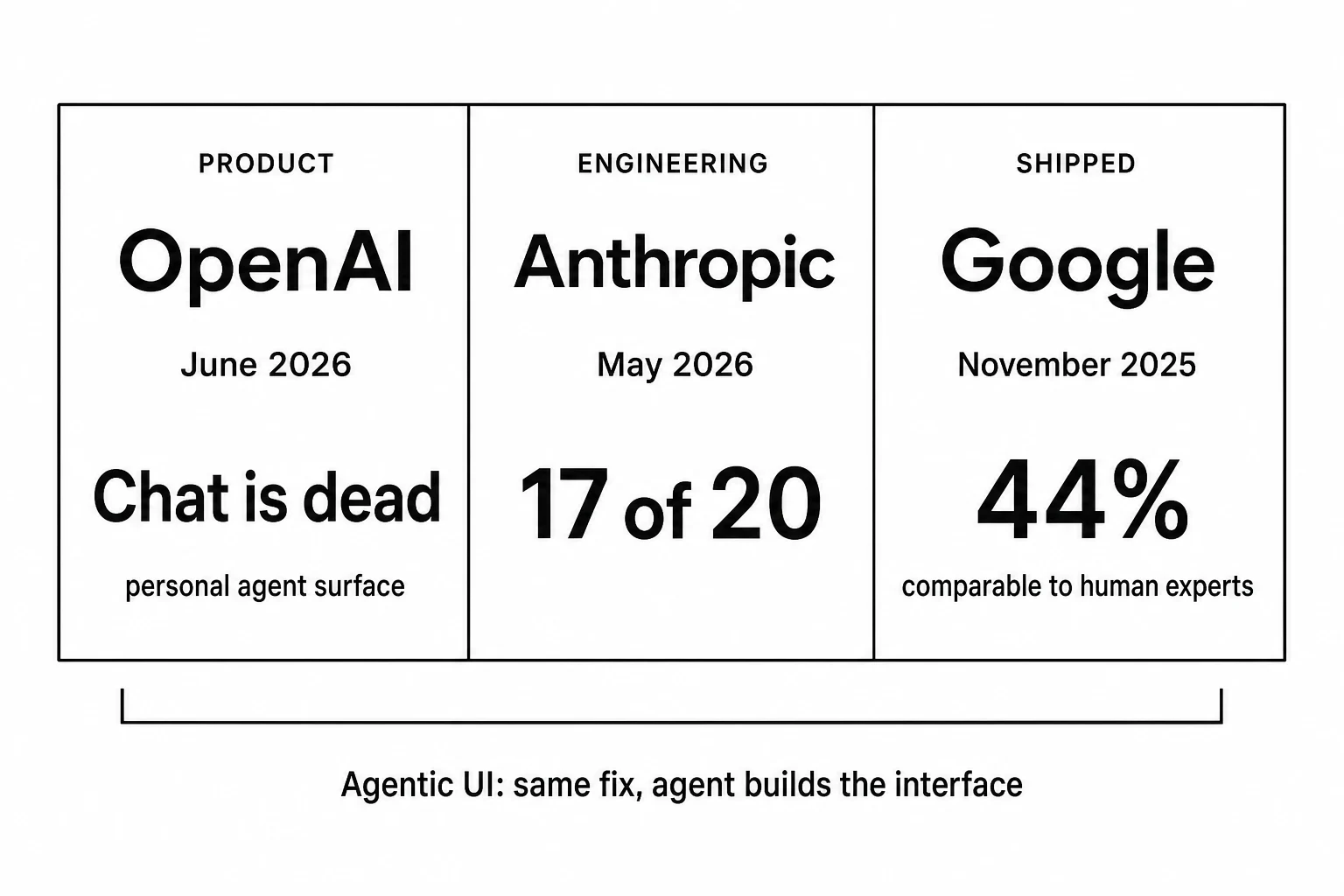
Three independent paths to the same interface pattern. Company names as text labels only.
Why chat was the right call, at the time
Chat happened by default, not by design: the first usable language models could only produce text, one token at a time, with no other output channel available. Once that was the only tool in the box, chat was a reasonable choice, arguably the only reasonable choice, for putting a language model in front of a user.
The cost of that constraint shows up once you look at what interface design normally does. Decades of UI convention exist precisely to compress meaning into a shape a person can read in a fraction of a second: a button says "you can act here," a slider says "this is a range," a table says "these things are meant to be compared." Plain text carries none of that. A paragraph describing three pricing tiers forces the reader to build the comparison table in their own head, sentence by sentence, that a real table would have handed them instantly. Academic work on this problem (the "Keyhole Effect" research on chat interfaces in data analysis) frames it exactly that way: a chat window is a narrow aperture, and every unit of structure the interface fails to provide becomes work the human has to do instead.
That tradeoff was survivable when model output was short and simple. It stops being survivable as the same model can now return a comparison across six variables, a multi-step plan with dependencies, or a form with conditional fields. The complexity of what a model can produce has grown faster than plain text's ability to carry it, and every increment of that gap gets paid for by the person on the other end of the conversation, not by the system generating the answer.
What agentic UI actually means
Agentic UI is the interface layer an agent generates and controls at the moment of the request: a form shaped by the specific task, a table sized to the actual data, a chart chosen because it fits the comparison being made, not a fixed template filled with generated text. Chat also "uses AI," so that is not the distinction that matters. What matters is whether the interface itself is the output, or only a frame around text that describes the output.
This is not the same thing as "an AI agent that automates a task in the background." An agent can run entirely headless. Agentic UI is what happens when that agent has to hand something back to a human: a working surface the person can act on directly, not a paragraph they have to finish elsewhere.
None of this makes chat obsolete as an input method. The idea already has a small stack of specs behind it: AG-UI carries the live connection between agent and app; A2UI and Open-JSON-UI describe which components to render, not raw code. In short, the model returns a structured interface description and the app renders it. That is server-driven UI, now driven by a model. CopilotKit frames the product choice as a spectrum (chat-plus-canvas, chat as fallback, or no chat), not a binary between "chatbot" and "no chatbot." Details for engineering teams sit in the FAQ.
Not theory: who is already shipping it
Three examples, three different contexts, same underlying move: the interface stops being a fixed shell and starts being generated around the specific task.
SAP put the shift in its own words in a March 2026 piece on Joule, its enterprise AI assistant: "The future of enterprise software isn't chatbots bolted onto legacy screens. It's bespoke mission control: interfaces that materialize around a user's intent, grounded in live data, executed by agents, and governed by the user." That is a vendor with decades of enterprise UI conventions to protect saying, in public, that the conventions are the problem.
HPE's internal agent, Alfred, is the operations version of the same idea. Built with Deloitte on HPE Private Cloud AI, Alfred runs four specialized agents that break a query into parts, analyze the underlying SQL data, build the chart, and write the structured report, cutting HPE's financial reporting cycle by roughly 40%. CFO Marie Myers described the goal behind the project herself: "We wanted to select an end-to-end process where we could truly transform rather than just solve for a single pain point. We wanted to operate differently."
EnterpriseSAP Joule
March 2026Mission control around user intent, not chatbots bolted onto legacy screens.
01
Interfaces that materialize around a user's intent, grounded in live data, executed by agents, and governed by the user.
SAP News Center, March 4, 2026.
OperationsHPE Alfred
Deloitte / Marie MyersFour agents: query breakdown, SQL analysis, charts, structured reports.
01
Roughly 40% cut to HPE's financial reporting cycle.
02
End-to-end process redesign, not a single pain-point fix.
The pattern is not limited to enterprise software vendors. We built Talkulate AI CPQ around the same principle at a different scale. On a hosting catalog, the buyer states the job in plain language. The agent returns the next questions and a plan the buyer can check on the same screen.
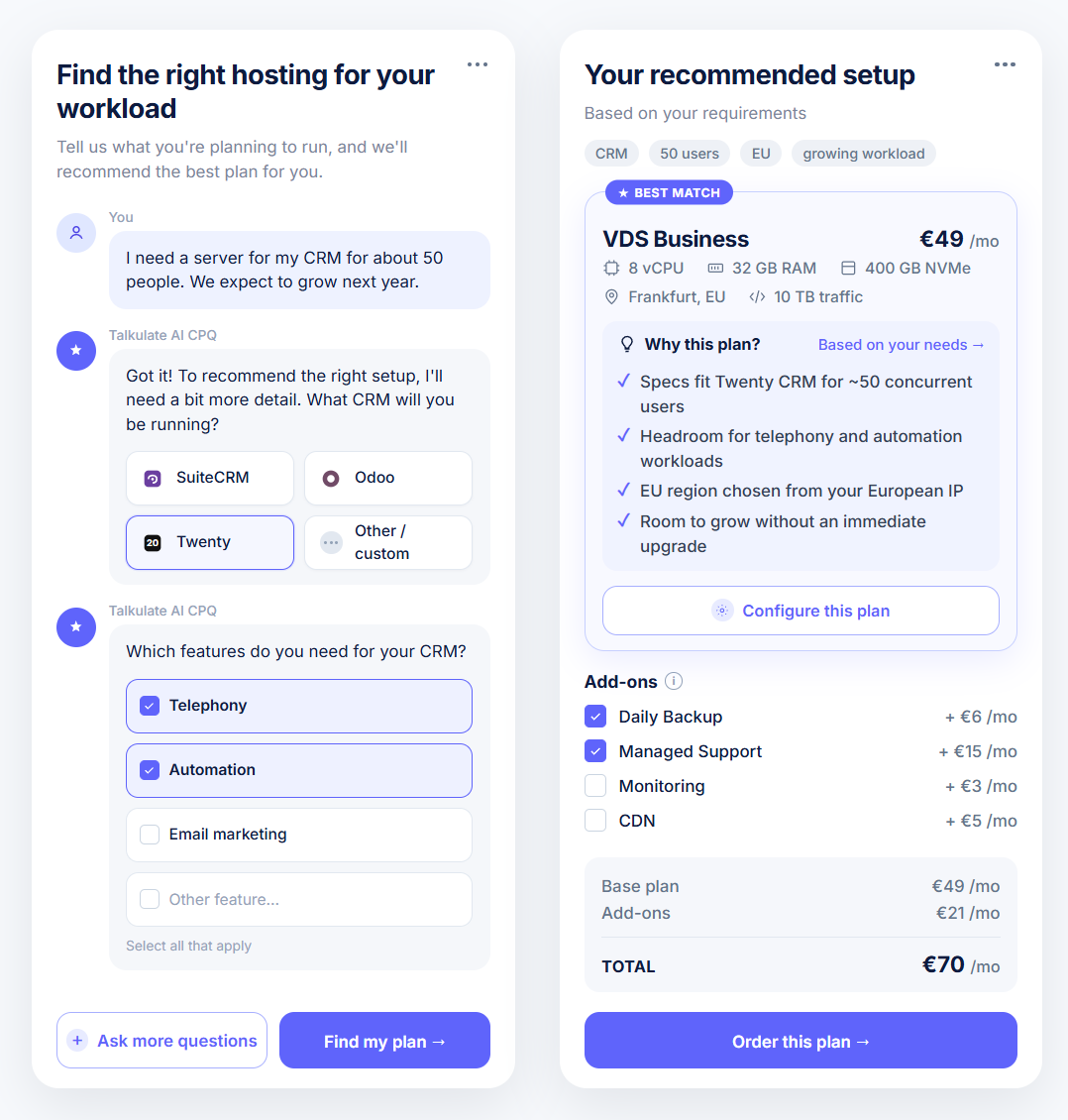
Talkulate AI CPQ: hosting adaptation
- The buyer names the job in one message: a CRM for about 50 people, with growth next year.
- The next question is chips: SuiteCRM, Odoo, Twenty, or other.
- Features are a checklist. Telephony and automation are on. Email marketing stays off.
- The offer repeats those answers as tags: CRM, 50 users, EU, growing workload.
- Best match shows the plan, specs, region, and traffic.
- Why this plan ties each reason to those answers.
- Add-ons change a live total before the order button.
None of these products removed conversation. They removed the assumption that conversation has to be the only surface, or the final one.
The cost of standing still
Employees now run a live comparison every day: the AI they use at home against the AI bolted onto their work tools. PYMNTS Intelligence's 2026 survey found 81% of Claude users and 71% of ChatGPT users say the tool is essential to their job or significantly boosts productivity, both well above what most teams report from internal chat tools. That gap is a daily grade on whether an employer's AI investment feels real or cosmetic.
Budget follows the same line. UiPath's 2026 research finds 78% of executives say they need to reinvent the operating model around agentic AI, not bolt AI onto the existing one. Gartner's forecast for projects that skip that redesign is blunt: more than 40% of agentic AI projects will fail by 2027, mostly because the systems underneath were never built for an agent to work inside them.
81% / 71% essential-or-productivity impact for Claude / ChatGPT users (PYMNTS). 78% of executives say the operating model must be reinvented (UiPath). Gartner: 40%+ of agentic projects fail by 2027.
People who use these systems can already tell an agentic surface from a chatbox wearing an AI label. Budget is starting to move toward whoever built the former.
Why teams still ship chatbots
If the technology is public, documented, and already shipping in production at Google, SAP, and HPE, the honest question is why so much of what launches in 2026 is still a chat window with a system prompt behind it. Four reasons explain most of it, in roughly ascending order of how defensible they are.
The first is simply outdated reference points. Plenty of product and engineering leads formed their mental model of "what AI interfaces look like" in 2023 or 2024, when chat genuinely was close to the state of the art, and that mental model has not been updated since.
The second is architectural convenience. A chat interface requires close to zero UX decisions: one input box, one scrolling output area, done. Building a surface that generates different widgets for different tasks means someone has to actually design those widgets, and that design work does not happen by accident.
The third is state. A chat transcript is stateless by design, each message just appends to the same list. An agentic interface has to track what is currently on screen, what happens when two generated widgets need to coexist or conflict, and what the "undo" story looks like. That is real engineering work that a chatbox lets a team skip entirely.
The fourth is the demo problem. A chatbot is the fastest thing a team can build that still looks, in a five-minute demo to an investor or a boss, like "an AI product." It requires no product thinking about what the user's actual workflow should look like once the AI is doing real work inside it, only a working input box and a model behind it.
All four are ordinary, not exotic: each one optimizes for the shortest path to something that demos well, then calls the output a finished product. Read our breakdown of what this costs in revenue.
The verdict
Two audiences are reading this section, and each one needs a straight answer, not a hedge.
If you are buying AI, and the tool you are paying for still hands you a chatbox in place of the workflow it claims to run, one of two things is true. Either the vendor has not shipped the agentic layer your subscription is already funding, or your own product is reselling customers a 2023 experience at a 2026 price. Skip the roadmap conversation. Ask the vendor to show you the actual widget-generation pipeline (what gets built on screen when a real request comes in), not a slide describing where it is headed.
If you are building AI internally, the facts do not leave much room: the technology is publicly documented, it is already running in production at large enterprises with heavy legacy stacks, and the reasons most teams still default to chat are architectural convenience, not a technical ceiling. A team that ships chat-only in 2026 made a scoping decision, whether anyone called it that out loud or not, and scoping decisions are fixable with the right brief and the right internal push.
That is the work we do week to week: agentic surfaces for quoting, reporting, and intake, including Talkulate AI CPQ.
Practical checklist
Before the next vendor call, or the next internal roadmap review, six questions separate a real agentic interface from a chatbot with a new label.
Can the tool show you data, rather than describe it in a sentence?
When you click a button the AI generated, what actually happens on screen, and how many steps sit between your question and a completed action?
If you ask a follow-up question, does the interface change to match the new context, or does it just add another paragraph to the same scroll?
Does the system track what is already on screen, or does every response start from a blank slate?
Who on the team made an explicit decision about what the interface should look like for this task, and when?
And, for anything you are paying for today: can the vendor show you the actual interface their agent generates for a real request, on the spot, without a scripted demo path?
Any "no" on the first three is worth raising before the contract renews or the sprint starts. Any "no" on the last three is worth raising with whoever owns the product decision.
Quoting, reporting, or intake still ending in a transcript?
Send us the brief or the current build. On a 30-minute call, we will show where a generated form, table, or configurator should sit before launch, or where it is missing today.
// What you get
Custom AI and agentic interfaces for mid-market teams: scoped from a blank page or from chatbot-stuck deployments already in production.
Sources
Primary reporting & vendor statements
[1]Financial Times. OpenAI ChatGPT overhaul / "chat is dead" reporting with Thibault Sottiaux (June 7, 2026; paywalled).
[2]OpenAI. Denise Dresser, "The next phase of enterprise AI" (April 8, 2026).
[3]PYMNTS. OpenAI declares chat dead in shift to super app (June 7, 2026): secondary reporting of the FT Sottiaux quote.
[4]SAP News Center. "Why Generative UI Is the New Frontier for Business Software" (March 4, 2026).
Engineering & research
[5]Simon Willison. Using Claude Code: The Unreasonable Effectiveness of HTML (May 8, 2026).
[6]Anthropic / Claude. Using Claude Code: The unreasonable effectiveness of HTML (Thariq Shihipar, May 2026).
[7]Towards AI. Independent HTML vs Markdown head-to-head on Shihipar's 20 prompts (17 of 20 for HTML).
[8]Leviathan, Valevski, et al. (Google Research). Generative UI: LLMs are Effective UI Generators.
[9]9to5Google. Gemini 3 launch coverage including generative UI (November 18, 2025).
[10]Chen, Zhang, Zhang, Shao, and Yang (Cornell / SALT-NLP). Generative Interfaces for Language Models (arXiv:2508.19227): humans prefer generative UI over chat in over 70% of cases.
[11]Reddy. "The Keyhole Effect: Why Chat Interfaces Fail at Data Analysis" (arXiv:2602.00947).
[12]MarkTechPost. "Beyond the Chatbox: Generative UI, AG-UI, and the Stack Behind Agent-Driven Interfaces" (January 29, 2026).
Enterprise cases & market data
[13]Deloitte Insights. "The agentic reality check: Preparing for a silicon-based workforce" (Tech Trends 2026): HPE Alfred / Marie Myers.
[14]CFO Dive. HPE CFO puts agentic AI at center of 2026 finance priorities (Marie Myers / Alfred).
[15]Alvandi / Navless. Guide GenUI layer on B2B sites: vendor-reported customer results (3× conversions; also bounce and session lifts).
[16]UiPath. 2026 AI and Agentic Automation Trends Report (78% reinvent operating model).
[17]PYMNTS Intelligence. Workplace AI productivity by platform (Claude 81% / ChatGPT 71%).
Frequently asked questions
Is chat dead?
Chat as the default product surface is being replaced. OpenAI's own leadership said as much to the Financial Times in June 2026, describing a shift toward an agent-first surface rather than a message window. Conversational input stays, but as one input method among several, not the entire interface.
What is agentic UI?
Agentic UI is an interface an AI agent generates and controls at the moment of a request: forms, tables, charts, or actionable widgets shaped by the specific task, instead of a fixed chat window filled with generated text. It answers the question "what should the user see and be able to do right now," the question a chatbot's plain-text reply cannot answer on its own.
What is generative UI, and is it different from agentic UI?
The two terms describe the same shift from two angles. Generative UI, the term Google and most research papers use, emphasizes that the model produces the interface itself, not just the content inside it. Agentic UI, the term CopilotKit and the AG-UI ecosystem use, emphasizes that an autonomous agent is driving that interface across a whole task, not a single response. In practice the two overlap almost completely; this piece uses "agentic UI" because the audience is deciding whether to buy or build one, not settling a taxonomy.
What is the difference between a chatbot and agentic UI?
A chatbot returns text describing information or an action. Agentic UI returns the information or the action itself, as a working interface element the user can act on directly. A chatbot can sit inside an agentic UI as one component (a text input or clarification thread); the reverse, an agentic UI reduced to a chat window, loses the structure that made it agentic in the first place.
What is AG-UI?
AG-UI (Agent User Interaction) is a protocol for the live connection between an AI agent and the app it runs inside: it carries events such as tool calls, state updates, and user actions back and forth in real time. It sits below the interface itself; separate specifications, including A2UI and Open-JSON-UI, define what the agent actually sends across that connection to describe which components to render. None of this is required knowledge for buying or commissioning an agentic product; it matters mainly to the engineering team building one.
Which companies have already shipped agentic UI?
Google shipped generative UI first, inside Gemini 3 in November 2025. SAP built its Joule Work experience around the same idea, live for enterprise customers since Sapphire 2026. HPE's internal finance agent, Alfred, generates charts and reports directly instead of describing them in text. Anthropic's engineering team is a related signal rather than the same product pattern: since May 2026 many of them ask Claude for interactive HTML specs and reviews instead of Markdown, because structured pages beat plain text when a human has to read the output. The first three are production product surfaces; the Anthropic case is production practice inside one lab.
Should we replace our AI chatbot?
Only if the chatbot is your entire interface today. The practical question is whether it is the whole surface or one component inside a broader agentic layer. If every task your AI performs still resolves to a paragraph the user has to read and act on manually, that is the gap worth closing first, regardless of whether the chat input itself stays.
Do we need to remove the chat input entirely?
No. CopilotKit's taxonomy of generative UI treats chat-plus-canvas, chat as a fallback, and no-chat-at-all as three points on one spectrum, not a binary choice. Many production agentic interfaces keep a chat input for open-ended requests while generating structured output for everything the system can resolve directly.
Does adopting agentic UI mean rebuilding our whole product?
No, and treating it that way is a common mistake. The practical path is to pick the single highest-value workflow that currently resolves to a paragraph of text (a quote, a report, a comparison, a plan) and rebuild the output layer for that workflow first. HPE took this approach with one process, financial reporting, rather than converting every internal tool at once. A working example on one workflow also makes the case for the next one far more convincingly than a slide deck would.
How long does it take to move a chatbot-only product to agentic UI?
It depends on how much of the underlying workflow already has structured data behind it. A product with a clean data model behind its chat layer can often ship a first agentic surface for its highest-value workflow within weeks; a product still figuring out its own data model needs that groundwork first, which is a separate, earlier project.
Is agentic UI worth the investment?
The data shows the gap already affecting performance, not just satisfaction. Employees who chose their own AI tool report meaningfully higher productivity than employees using a mandated one, and 78% of executives in UiPath's 2026 research say their operating model needs to change to capture agentic AI's value. Deloitte puts the adoption gap in numbers: only 11% of organizations have agentic systems in production today, even though 38% are already piloting one. Gartner's counterpoint is the risk of doing it badly: more than 40% of agentic AI projects are expected to fail by 2027, mostly because the surrounding systems, not the model, were never built for an autonomous agent to work inside them. The real question is not whether to invest, but whether the first workflow chosen is one where that failure mode does not apply.
Can agentic UI go wrong?
Yes, and Deloitte has a name for the failure mode: "workslop," agentic tools built without redesigning the underlying process, which end up adding work instead of removing it. The failure is almost never the model's inability to generate a good interface; it is skipping the process redesign and state-management work a real agentic surface requires, then shipping the result anyway because it demoed well. The fix is the one HPE used: pick one real end-to-end process, not a single pain point, and redesign it properly before generating the interface for it.
Want help applying this?
Tell us what you are trying to ship. We will tell you, honestly, whether AI is the right tool and what it would take.