AI and Jobs: What Data Shows for Sales Tech
Topics
- AI labor market sales
- presales AI automation
- B2B sales AI jobs
- observed exposure AI
- AI qualification software
- guided selling AI
- Talkulate AI CPQ
- sales automation ROI
- Anthropic workforce AI
Headlines say AI will take your job. The data says something else.
Anthropic's March 2026 labor market study introduces observed exposure: not what AI could do, but what it actually does in professional settings. The difference matters for anyone thinking about sales automation.
Executive Summary
94% → 33%
Computer & Math: theory vs observed
75%
Computer programmers — highest AI coverage of any occupation
−14%
Job entry rate for workers 22–25 in exposed roles (post-ChatGPT)
47%
Higher average pay in high-exposure vs zero-exposure occupations
~30%
Workers with zero AI exposure in any task
−0.6pp
BLS employment growth drop per +10pp observed AI coverage
The Situation
Anthropic's study measures observed AI exposure: what Claude actually does in professional settings. The gap between observed usage and theoretical capability is the most important number in the report.
Across every occupational category, real usage trails theoretical feasibility by 30–65 percentage points. AI is being used, but far more narrowly than models suggest it could be.
How It's Measured
Three data sources combined into one metric:
- O*NET: task-level data for ~800 US occupations
- Anthropic Economic Index: actual Claude usage in professional settings (Aug + Nov 2025)
- Eloundou et al. (2023): theoretical LLM feasibility scores per task
Automated use counts fully; augmentative use counts at half weight. Work-related context weighted over casual use.
Key Data Points
- Computer & Math: 94% theoretical → 33% observed (−61pp)
- Office & Admin: 90% theoretical → ~25% observed (−65pp)
- Sales & Related: ~60% theoretical → ~15% observed (−45pp)
- Computer Programmers: 75% coverage — highest of any occupation
- High-exposure workers earn 47% more on average than zero-exposure workers
- ~30% of all workers show zero AI exposure in any task
- No systematic unemployment increase since late 2022
Important Caveat
The study uses Anthropic Economic Index data — actual Claude usage patterns. This measures what Claude users do; non-Claude AI tools are not captured. The observed exposure figures are a lower bound on real AI usage in the economy.
The gap between theory and observed usage is where sales automation lives today. Tools that automate structured workflows (config, quote, qualification) are capturing real value. The human remains essential for judgment, relationship, and exceptions.
The gap: theory vs reality
AI covers a fraction of what it theoretically could. In Computer & Math occupations, theory suggests 94% of tasks are LLM-feasible; real observed coverage is 33%. The gap is 61 percentage points.
The study combines three data sources to build observed exposure — a measure of what AI actually does in professional settings (as opposed to theoretical task feasibility):
- O*NET task data: enumerates tasks for ~800 US occupations
- Anthropic Economic Index: actual Claude usage, weighted toward automated and work-related contexts
- Eloundou et al. (2023): theoretical LLM feasibility scores (β) per task
Result: a measure that weights automated use more than augmentative, and work-related context over casual use. Observed exposure is lower than you'd expect from capability hype.
The Gap in Numbers — Anthropic Labor Market Study, 2026Figure 2
| Occupation | Theory → Observed | Gap |
|---|---|---|
| Computer & Math | 94% → 33% | −61pp |
| Office & Admin | 90% → ~25% | −65pp |
| Sales & Related | ~60% → ~15% | −45pp |
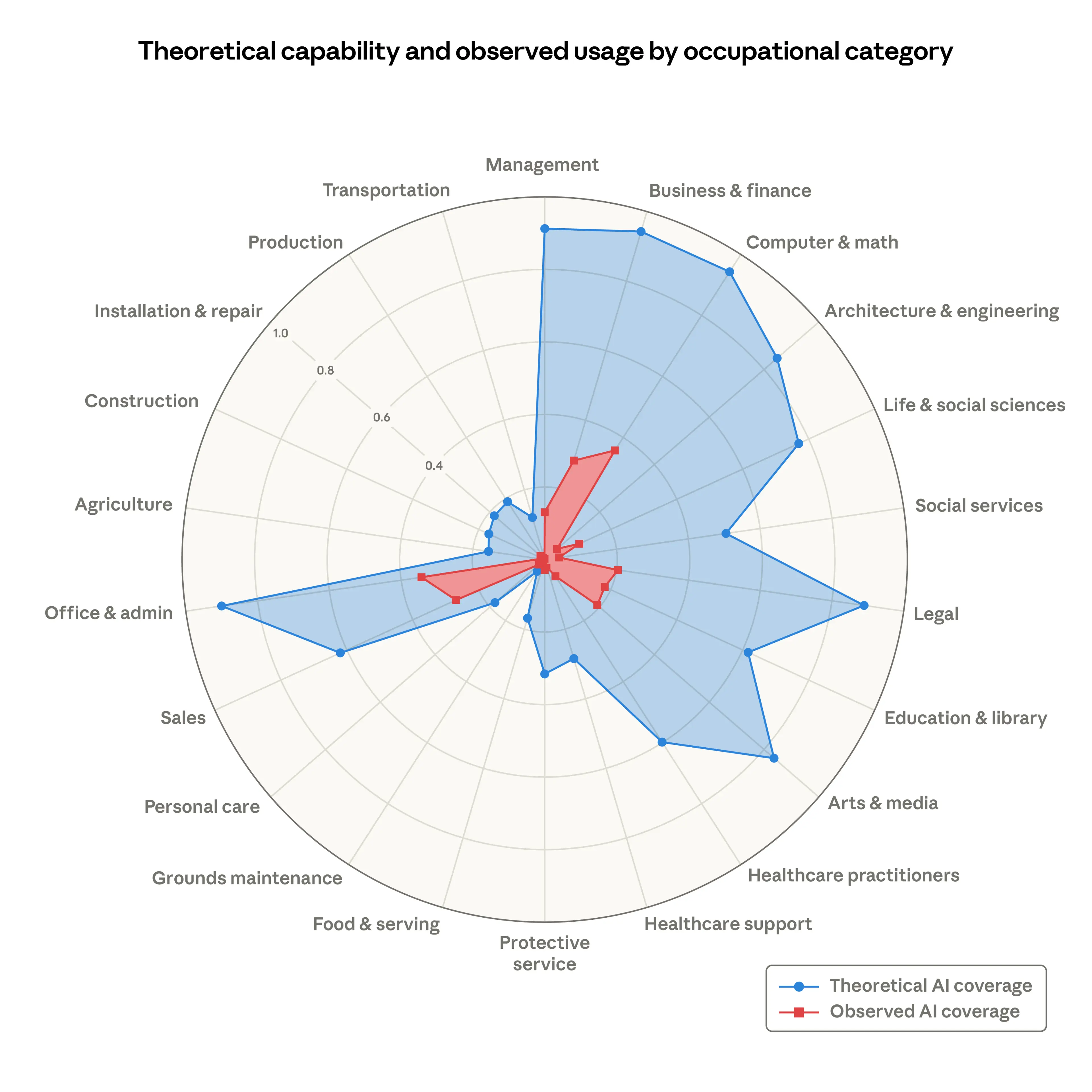
Source: Anthropic, Labor market impacts of AI, Figure 2. Reproduced under fair use.
Top Exposed Occupations
01Computer ProgrammersCoding, debugging, code review: extensively automated via API75% coverage
02Customer Service RepsFirst-party API traffic: high share of automated, work-related usageHigh coverage
03Data Entry KeyersReading source documents and entering data: primary task sees significant automation67% coverage
~30% of all workers have zero coverage: cooks, mechanics, bartenders, lifeguards. Physical and situational tasks remain outside current AI reach.
Who are the highly exposed workers? The demographics are counterintuitive. Compared to zero-exposure workers, the most exposed group is:
- 16pp more likely to be female
- 47% higher average earnings
- ~4× more likely to hold a graduate degree (17.4% vs 4.5%)
- More likely to be white or Asian
AI is not primarily threatening low-wage, low-skill work. It's concentrated in educated, well-paid, knowledge-intensive roles.
Who's exposed, who isn't
Participant
High Exposure
Role
Structured, language-heavy, knowledge-intensive tasks
Gains
- Routine structured tasks automatable — frees capacity for higher-value work
- AI augmentation is shipping today: programmers see 75% Claude coverage on real tasks
- Qualification, config, proposal drafting: clear AI wins in sales-adjacent roles
- Higher-paid workers (47% premium) — AI tools accessible and already in use
Risks
- Hiring of workers aged 22–25 into exposed roles down ~14% post-ChatGPT
- Entry-point erosion: displacement appears in hiring rates for 22–25 year olds, with no layoff spike yet
- BLS projects −0.6pp employment growth per +10pp observed coverage
- Computer programmers, customer service, data entry most at risk of scope reduction
Participant
Low Exposure
Role
Physical, situational, contextual work
Gains
- No systematic unemployment increase — data confirms stability through late 2025
- Physical and manual tasks remain outside current AI reach
- Relationship selling, negotiation, complex exceptions: durable human advantage
- Contextual judgment — the moat that current LLMs cannot replicate
Risks
- Indirect pressure as AI-augmented competitors operate faster and cheaper
- Adjacent structured tasks may shift to AI as capabilities advance
- Cooks, mechanics, bartenders are low-exposure in the 2026 snapshot; physical-task safety is not guaranteed long-term
- Complacency risk: "low exposure" reflects current capability and adoption, both of which keep moving
No unemployment spike — but watch the hiring data
The headline finding: no systematic increase in unemployment for highly exposed workers since late 2022. But the study flags a more subtle signal that matters more for sales teams.
Hiring of workers aged 22–25 into AI-exposed occupations has slowed by ~14% post-ChatGPT (Figure 7). Job finding rates at less-exposed occupations remain stable at 2% per month; entry into the most exposed jobs has dropped by about half a percentage point. Workers over 25 show no comparable effect.
What the data confirms, suggests, and doesn't show
- Confirmed: No spike in unemployment rates for high-exposure occupations since late 2022
- Confirmed: Observed AI coverage is far below theoretical capability across all categories
- Confirmed: BLS employment growth projections are weaker for higher-coverage occupations (−0.6pp per +10pp coverage)
- Suggestive: ~14% slower hiring of 22–25 year olds into exposed roles — consistent with AI reducing entry-level demand, but just barely statistically significant
- Suggestive: Young workers not hired may stay in existing jobs, take different jobs, or return to school; unemployment is one possible outcome among several
- Not confirmed: Whether the hiring slowdown is AI-driven or cyclical — the study explicitly flags this as an open question
- Not measured: Impact of non-Claude AI tools — the data is Anthropic-specific and likely understates total AI usage
What this means for sales tech
Presales and qualification are classic "structured but contextual" tasks: AI handles the structured layer (config, validation, proposal generation) while reps own the contextual layer. That's where current tools are already delivering.
AI Sales ToolTalkulate AI CPQ
Handles structured presales; human owns relationship and sign-offInterviews the prospect, validates requirements against the product catalog, and delivers a complete quote. The agent handles the structured part; the human handles edge cases and final approval.
01Prospect interview — agent asks qualification questions, captures requirements in structured format
02Catalog validation — requirements matched against product rules, constraints, and pricing logic
03Quote generation — complete, accurate proposal produced without rep involvement in the structured steps
→Rep reviews, handles exceptions, owns the relationship and closing conversation
AI Sales ToolTalkulate Light
Turns a short conversation into a personalized proposalTurns a short conversation into a personalized proposal. The AI collects context and runs your logic; the rep owns the relationship and closing.
01Context collection — conversational interface captures prospect needs, budget signals, and decision criteria
02Logic execution — your qualification and pricing rules run automatically against the collected context
03Personalized proposal — output formatted with the prospect's context and your pricing, ready for rep review
→Rep delivers the proposal, handles objections, and closes — AI handled the structured preparation
The gap between theory and observed usage is where most sales automation lives today. Tools that augment clear workflows (config, quote, qualification) thrive. The human remains in the loop for judgment and trust.
Bottom line
- 01Theory vs Reality
AI's observed impact lags its theoretical capability by 30–65 percentage points, depending on occupation. This gap is the most important number in the Anthropic study and the most underreported finding in AI coverage.
- 02No Spike — Watch Hiring
No unemployment increase for exposed workers. But hiring of 22–25 year olds into exposed roles is down ~14%. Displacement is concentrated at the entry point and shows up in hiring rates rather than layoff filings.
- 03Sales: Capture the Structured Gap
Automate config, proposal, and qualification: these are the structured tasks where AI coverage is real and growing. Keep humans for relationship, negotiation, and exceptions. That's the durable division of labor the data supports.
Bottom line
That's what the data shows. The hype is ahead of reality, which leaves room for tools that get the balance right. The window to capture the structured gap is open. It won't stay that way.
References and Sources
Primary Source
[1]Massenkoff, Maxim and Peter McCrory. "Labor market impacts of AI: A new measure and early evidence." Anthropic, March 5, 2026.
[2]Handa, Kunal et al. "Which Economic Tasks are Performed with AI? Evidence from Millions of Claude Conversations." Anthropic Economic Index, 2025.
Task Exposure Methodology
[3]Eloundou, Tyna, Sam Manning, Pamela Mishkin, and Daniel Rock. "GPTs are GPTs: An Early Look at the Labor Market Impact Potential of Large Language Models." arXiv:2303.10130, 2023.
[4]O*NET Online — Occupational Information Network. US Department of Labor task database used for occupational exposure scoring.
Labor Market Evidence
[5]Brynjolfsson, Erik, Bharat Chandar, and Ruyu Chen. "Canaries in the Coal Mine? Six Facts About the Recent Employment Effects of Artificial Intelligence." Digital Economy, 2025.
[6]Gimbel, Martha et al. "Evaluating the Impact of AI on the Labor Market: Current State of Affairs." The Budget Lab at Yale, October 2025.
[7]Hampole, Menaka, Dimitris Papanikolaou, Lawrence DW Schmidt, and Bryan Seegmiller. "Artificial intelligence and the labor market." NBER Working Paper, 2025.
[8]Johnston, Andrew and Christos Makridis. "The labor market effects of generative AI: A difference-in-differences analysis of AI exposure." SSRN 5375017, 2025.
BLS Employment Projections
[9]US Bureau of Labor Statistics. Occupational Outlook Handbook — Employment Projections 2024–2034. Published 2025.
Frequently asked questions
Does AI replace sales jobs?
Anthropic's data shows no systematic unemployment increase in AI-exposed occupations since late 2022. AI coverage lags far behind theoretical capability. For jobs that combine structured tasks (config, quote, qualification) with human judgment, AI augments rep workflows; full role replacement is not visible in the data.
Which jobs are most exposed to AI?
Computer programmers (75% coverage), customer service reps, data entry, financial analysts. Sales-adjacent roles: qualification, first-line config, routine proposal drafting. Least exposed: physical and manual tasks (cooks, mechanics, bartenders).
What does AI exposure mean for presales automation?
The gap between theoretical AI capability and real usage is large. Presales tasks — config, validation, quote generation — sit in that gap. Tools like Talkulate AI CPQ and Talkulate Light automate the structured part; humans handle exceptions, relationship, and final approval.
What is observed exposure?
Observed exposure is Anthropic's new measure combining theoretical LLM capability with real Claude usage data. It weights automated use more than augmentative, and work-related context over casual use. The result is far lower than theoretical estimates — showing how much of AI's potential remains uncaptured.
Has AI caused unemployment to rise?
No systematic increase in unemployment has been detected for highly exposed workers since late 2022. However, there is suggestive evidence that hiring of younger workers (22–25) into AI-exposed occupations has slowed by approximately 14%. The displacement signal is concentrated at the entry point: fewer new hires rather than layoffs of incumbents.
Want help applying this?
Tell us what you are trying to ship. We will tell you, honestly, whether AI is the right tool and what it would take.